

Major Fallacies and Failures are Damaging Trump’s Economic War
When will the "course correction" begin?

For the past several months, I have been reading and listening to the opinions of experts on economics, trade policy and tariffs. They help shape my thinking on the reasons for and the consequences of Trump’s Economic War. These ideas and opinions, sometimes contradictory, allow me to write this newsletter. In this week’s issue, I will share with you three perspectives on trade and tariffs.
A Macroeconomic look at Trade and Tariffs
The first video, prepared by the Wall Street Journal, provides a macroeconomic perspective on trade and tariffs.
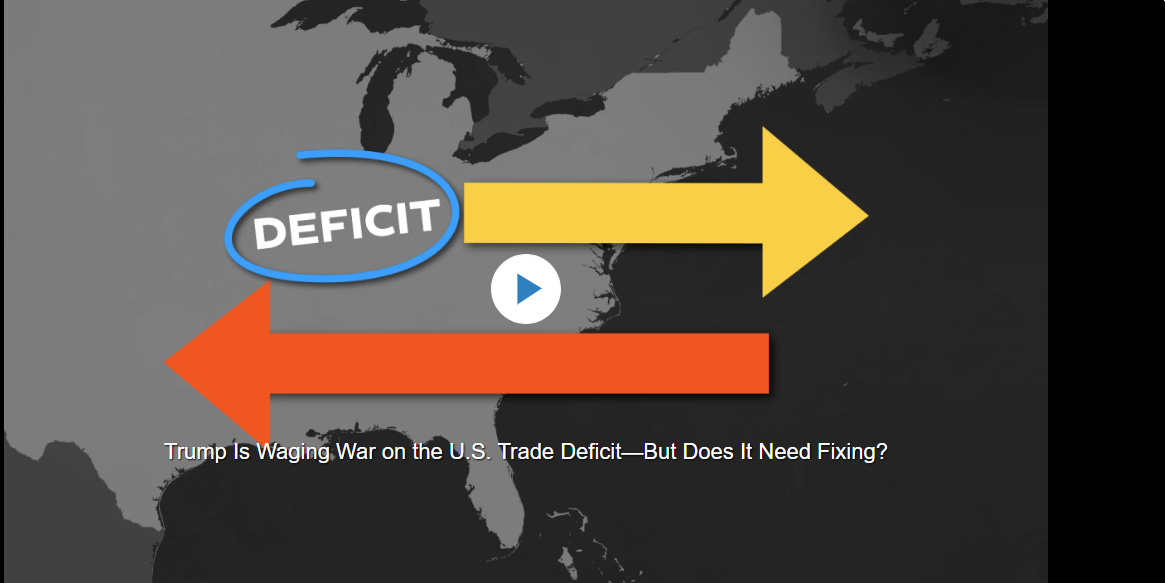
Madeleine Marshall of the WSJ states that when evaluating trade patterns, economists believe that one should not look at country by country bilateral trade but look at global trade. Ms. Marshall makes the point that the United States has run a trade deficit on goods for a long time. America spends more on goods that it imports versus its exports to other countries. Economic growth creates wealth; wealthy Americans can afford purchases of foreign goods thereby, driving up the deficit on goods. America consistently runs a surplus on services (e.g. tourism, consulting).
Maurice Obstfeld, Senior Fellow at the Peterson Institute, states in the video that it is neither good nor bad to run a trade deficit. However, when America runs a trade deficit, some of this money gets reinvested into America from its trading partners. This is not something that receives much discussion. These investments boost the American economy.
The video also points out another item that is overlooked. Some of the deficit comes from congressional spending, specifically government spending that exceeds budget estimates. Congress takes on debt by selling bonds, including some to foreigners. On the question of whether tariffs affect the overall deficit, “the answer is no.” As Mr. Obstfeld points out, tariffs raise prices. Higher prices depress spending and exports. If deficits decline because citizens choose to save more, or governments decide to send less, those are good things, but not likely outcomes. If the deficit declines because America encounters a recession, that is also not a good result.
China’s economy is in trouble, but they will not cave in
At The New Yorker, Isaac Chotiner hears from MIT China expert Yasheng Huang: “I think it’s clear [China’s leaders] don’t want a trade war. Their economy is struggling, and the export sector has been one of its few bright spots. Last year, they had almost a trillion-dollar trade surplus. . . I don’t think they want to cave in. That would make the Chinese leadership look very bad. And, moreover, I don’t think they trust the Trump Administration.”
In the second video Jan Jekielek, Senior Editor of the Epoch Times, speaks with Gordon Chang, an American lawyer, political commentator and author, who lived and worked in mainland China and Hong Kong for almost two decades. He wrote a book entitled “The Coming Collapse of China.”
Mr. Chang is of the view that Trump’s team is in negotiations with about 130 countries that will sign deals, over time, since they need access to America’s large, rich consumer market. It is his belief that foreign countries need access to the American market more than the U.S. needs access to their markets. “Economic reality will set in.” This will be good for the United States but not good for China.
Mr. Chang suggests that “Trump holds all the cards.” China can threaten to not export rare earths to the U.S. and to not buy Boeing aircraft. But Mr. Chang believes that Trump has leverage since China will need Boeing parts to fly the Boeing planes that it owns, and it needs access to U.S. consumers.
Chang argues that Trump is going to orchestrate “a restitching of trade and the American consumer is not going to feel it.” Americans may face higher costs, but “this is a cost we will have to face;” otherwise, we will become “a vassal state of China.” To avoid this from happening, America needs to take this opportunity to regain its manufacturing capabilities. If America does not succeed, it will become a “wasteland.” Chang views this trade war with China as an “existential threat” to the United States. “We better win it.”
The Five Major Fallacies behind Trump’s Tariffs
In the third video, Larry Summers, Professor and President Emeritus, Harvard University, offered the following thoughts in a discussion with the Peterson Institute.
Fallacy 1. “There is no logic to thinking about bilateral deficits as a measure of exploitation.”
The countries in the world have different population sizes, unique sets of natural resources, and are at distinct stages in their economic development. The U.S. has a trade deficit with China because American manufacturers decided many years ago that it was less expensive to manufacture in China and have the goods shipped to America, rather than manufacture the goods in America. Similarly, America has a trade deficit with Canada since it has a population ten times the size of Canada’s population, it needs the three million barrels of crude oil that it imports daily from Canada, it needs its potash, aluminum, and hydroelectric power. If America could find other sources of these materials, the deficit with Canada would disappear.
Fallacy 2. “Trade Deficits are always bad”
Trade deficits and surpluses are based on economics, geography, politics, and other variables. They are not inherently good or bad.
Fallacy 3. “Tariffs are not a major determinant of a level of trade deficits.”
Mr. Summers opines that tariffs can be useful in protecting certain industries (e.g. The U.S. levies tariffs on imports of Chinese EV vehicles to minimize their impact on the U.S. E.V. industry.). When applied more broadly, tariffs create trade distortions rather than solutions. They raise prices on imported goods and thereby, reduce consumption. As outlined above, trade deficits and surpluses are a result of a host of variables.
Fallacy 4. “Manufacturing is not going to be a major source of opportunity for Americans going forward.”
Summers points out that “everybody has a declining share of manufacturing, including China, because it is all being driven by patterns of technology, not trade.” Costs and advanced production techniques, including the use of robotics, are the key drivers of geographic shifts in production facilities. Tariffs are not going to bring manufacturing jobs back to America.
Summers also makes the point that of the 8% of U.S. jobs in manufacturing, 4% are in accounting, sales - - - and other support functions, not manufacturing. Pure manufacturing jobs are at 4% of American employment figures and “sharply declining.” To think that “bringing back manufacturing jobs to American will be transformational is completely delusional.”
Fallacy 5. “Indiscriminate tariffs are a form of manufacturing subsidy.”
Summers uses the example of the steel industry. Sixty percent of jobs in the steel industry are steel processing. Placing a tariff on steel processing raises the costs of all products that utilize steel as components of their products (e.g. cars, construction, ships, planes), thereby, “hurting rather than increasing competitiveness.”
Mr. Summers then discusses the “cyclical dynamics” of tariffs. They produce “stagflation.” Higher prices result in reduced spending that result in reduced employment. He quotes a study from the Yale Budget Office that tariffs will cost $4800 per year per American family. This “supply shock” is “equivalent to a doubling of the price of oil.” This is a “conservative” estimate since it doesn’t reflect the impact of retaliatory tariffs. Tariffs are producing a self-inflicted “financial crisis.” He states, “we have taken uncertainty to epic levels.”
America has “lost its soul”
In the opening video, the Wall Street Journal posits that one should not focus on bi-lateral trading relationships when looking at global trade and trading patterns. However, a country’s total balance of trade is the summation of its individual trading relationships. Trump’s tariffs vary country by country, depending on its trade surpluses and deficits with each of its 180 trading partners.
Mr. Chang argued that Trump’s economic war would trigger a restructuring of international trade. He suggested that America is now in the process of negotiating trade agreements with 130 countries.
Nobel-winning Economist Paul Krugman, writing in his Substack, stated the following. “Here’s what Trump and his sycophants don’t understand about international trade: It’s not about what you can sell, it’s about what you can buy . . .
The benefits from international trade basically come from being able to import goods that would be expensive or impossible to produce at home. Think hydroelectric power from Canada.
This fundamental reality explains why serious analyses of Trump’s trade war with China often conclude that China, not America, has the upper hand. Yesterday the Financial Times . . . pointed out that US exports to China are ‘heavily focused on agriculture.’ what matters in a trade war is the fact that China can fairly easily find other agricultural suppliers, buying soybeans from Brazil instead of Iowa. By contrast, the United States will have a hard time replacing many of the goods it imports from China. Furthermore, many of the goods we buy from China are industrial inputs rather than consumer goods . . . “ He concluded his article with four items that are hurting America’s chances of success.
1. “There is no policy process.”
“One thing that’s clear about Trump tariffs is that there is no policy process. Individual officials — Bessent, Peter Navarro, Howard Lutnick — keep floating policy ideas in public, hoping that putting them out there will somehow create facts. But a day or two later another official will go on TV, or Trump will post something on Truth Social, completely contradicting what the last official said.”
2. “Trump has lost all credibility.”
Even if U.S. negotiators are trying to cut deals with other countries that would isolate China, they will be unlikely to succeed because Trump has lost all credibility. “After all, you can’t make deals with other countries unless foreign governments believe that you will honor the agreements you make. Trump has already destroyed U.S. credibility on that front, ripping up all our existing trade agreements, then making wild changes in his own tariffs every few days.”
3. Why would a European government “destroy its own supply chains?”
Even if Trump’s promises were credible, why would a European government want to join America’s trade war with China, destroying its own supply chains? “If the argument is that it’s worth paying the cost of ruined supply chains because that will protect you from Trump’s tariffs, who trusts Trump not to reimpose punitive tariffs on our supposed allies the next time he thinks they’re looking at him funny?”
4. The Trump administration is “bringing a knife to a gun fight.”
“To the extent that there’s a real plan to confront China, it appears to center on reducing China’s ability to sell abroad. It’s true that this will be painful for China’s export sector . . . But China can cope with lost exports by aiding affected industries, the same way Trump funneled money to farmers hurt by his first trade war. It can also offset any loss of export jobs by stimulating domestic demand. Moreover, Xi and the Chinese Communist Party don’t face elections.
So while China can manage the loss of exports in various ways, it will be much harder for America to cope with the loss of crucial inputs produced in China . . .
China has brought a gun that is strangling us by cutting our supply chains . . .
Furthermore, America’s ability to fight a trade war is severely damaged by our descent into authoritarian rule . . . Now we’ve become a country whose government claims the right to kidnap people whenever it likes and ship them to foreign gulags. Who wants to be allied with such a government? Who will trust such a government to keep its word on anything?
Of course, the fact that the collapse of democracy will contribute to our defeat in the trade war isn’t the main reason to be horrified at where we are. Losing real GDP is bad, but it’s much less important than losing our soul. As it happens, however, we seem to be on track to do both.”
The last word goes to Larry Summers. “This is by far the most dangerous moment since the end of the cold war, and I believe we are looking at the possibility of a period of epochal change where America will move away from a long tradition of democracy with profound consequences.” This “unprecedented and massive self-inflicted economic wound requires a course correction that has never been more necessary than in the United States today.”